Cowls

for the

flexee

loom

Skinny

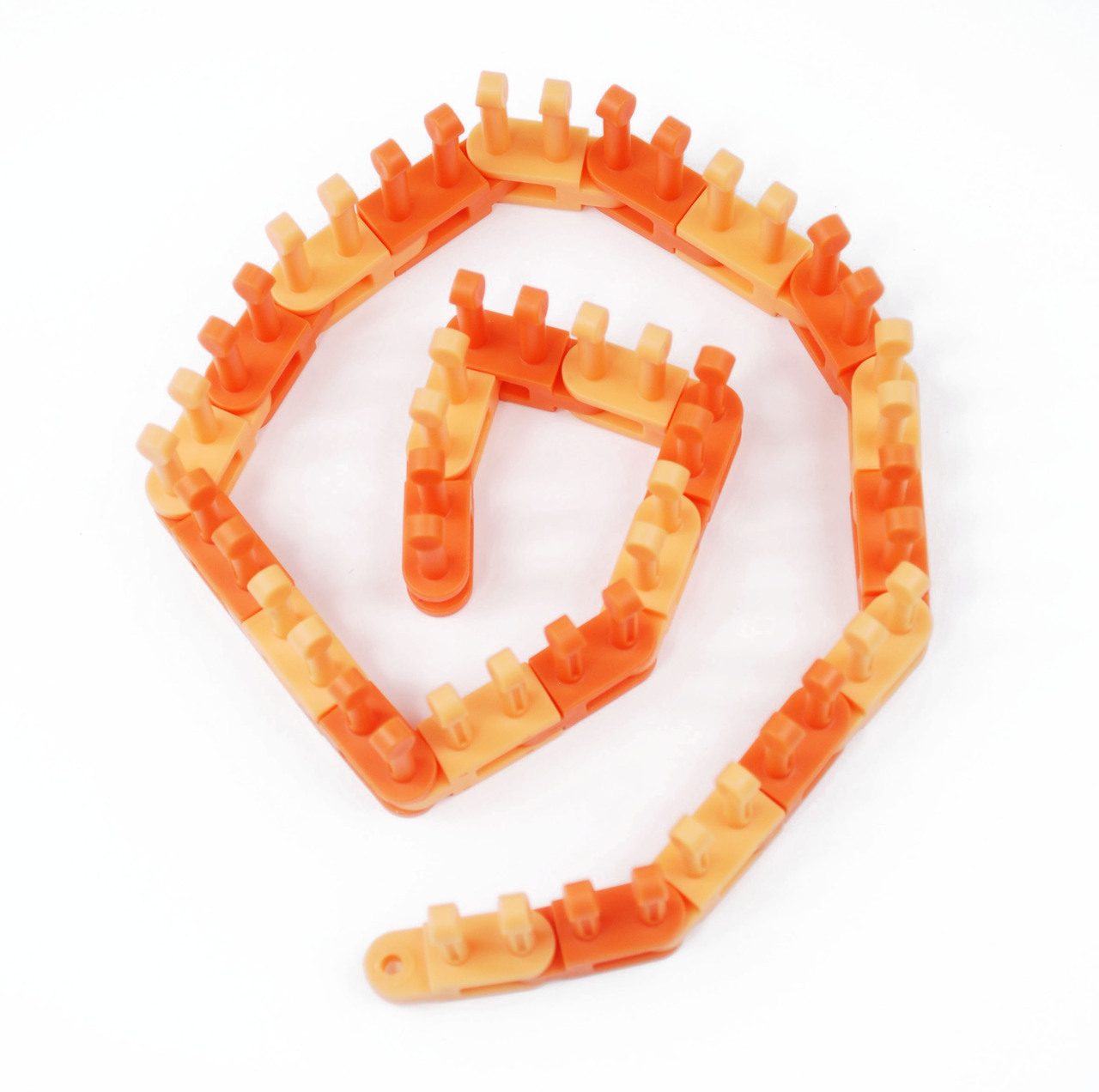
Loom knitting 3/8″ gauge links that can make any size flexible knitting loom up to 96 pegs. Kit includes 48 links. Size 3/8″ – small gauge for worsted weight, #3 or #4 yarn.

Regular

Loom knitting regular gauge links that can make any size flexible knitting loom up to 84 pegs. Kit includes 42 links. Size 1/2″, regular gauge for medium weight yarn, #4 or #5, heavy worsted, or chunky yarn.

Chunky

Loom knitting links that can make any size flexible knitting loom up to 72 pegs. Kit includes 36 links. Size 5/8″ – large gauge for bulky yarn.

Table of Contents

What is a cowl?

2 Ways of constructing a cowl

In The Round

Worked Flat

Loom Knitting Basics

Casting On

This is the single e-wrap cast on.

Tie a slip knot and a attach it to the anchor peg.

Wrap the first peg to the right (counter clockwise on the loom) around from back to front to back, like in the picture.

Once the first peg is wrapped, continue to the next peg, to the right, wrap completely around, crossing in the back,

Do the same for every peg on the loom, until all the pegs are wrapped if knitting in the round, or the amount required are wrapped.

To continue in the round, simply wrap from the last peg to the first peg as if it were any other peg, and continue!

This is the simplest cast on. Make a slipknot, put it on the first peg, and then e-wrap all of the pegs you need (either flat or in the round). Then start the pattern. It is simple, but can look sloppy.

E-Wrap Cast On

Knit Stitch

The only knit stitch I use in my patterns is the e-wrap knit stitch.

E-wrap: (K, EW, EWK) The most basic knit stitch, used most commonly. Wrap the peg and lift the existing loop over. This is the loosest knit stitch.

1. Set up for the e-wrap

Wrap all of the pegs around the loom and start a new row. In the round, this means continuing past the last peg and wrapping the first one the same wa,

2.Wrap the peg

Wrap the peg on top of the first wrap so there are now 2 wraps on the peg.

3. Pull the loop over

Using the knitting tool, lift the bottom loop and bring it up and over the top loop and peg. The stitch is complete, continue and repeat on all pegs.

Purl Stitch

Purl: (P).Put the knitting tool through the loop on the peg from top to bottom, grab the working yarn with the tool, pull it up through the loop and remove that loop from the peg, and put the new loop you just formed onto the peg. Be careful not to pull too tight, keep the working yarn loose.

1. Insert the hook to grab the working yarn.

Put the knitting tool downwards through the existing loop to grab the working yarn to start the stitch

2. Grab the working yarn and pull it through the loop and up.

Pull the working yarn through and up into a new loop of its own.

3. Remove the existing loop from the peg and replace it with the loop you just made.

Take the newly formed loop and place it onto the peg, pushing the old loop off.

Binding Off

E-wrap peg 2, move the new stitch to peg 1, knit over, then move peg 1 to peg 2. Then e-wrap peg 3, move the new stitch to the just-moved stitch on peg 2, knit over, and move that loop to peg 3. Continue until there is one stitch left and then take a needle and pull through the last loop, like a gather bind off. Do this loosely.

Step 1: Wrap and knit off pegs 1 and 2.

Step 2: Move the loop on peg 2 to peg 1.

Peg 2 is empty and there are 2 loops on peg 1.

Step 3: Knit off peg 1 (bring the bottom loop over the top loop).

Next you'll move the loop from peg 1 to peg 2, and the first stitch is bound off.

Step 4: Move the remaining loop back to the empty peg. This peg is now peg 1.

The first stitch is bound off, peg 1 is empty, peg 2 is now peg 1, and peg 2 is the next stitch in.

Step 5: Wrap and knit off (the new) peg 2.

This sets up the pegs on the loom to be cast off using the same steps again.

Step 6: Repeat steps 2 - 5 until there is one loop left on the loom.

As you continue, the finished product has a nice, braided, even edge. After there is one peg left, you can cut the yarn and finish as described.

Step 7: Wrap the peg with the loop on it and knit off. Cut the yarn, leaving a 6" tail. Take the loop off the peg and pull on it until the cut end of the yarn comes through. Continue pulling until the loop is closed snug against the knit fabric.

Dictionary

CO: Cast On

E-Wrap Cast On (EWCO, CO)

This is the simplest cast on. Make a slipknot, put it on the first peg, and then e-wrap all of the pegs you need (either flat or in the round). Then start the pattern.

Double E-Wrap Cast On (DCO, CO)

This is a simple, tight, good looking cast on, but tension must be kept well or it can look sloppy. Wrap the peg twice, then bring the bottom loop over the top loop and repeat on the next pegs.

Crochet Cast On (CCO)

Make a slipknot and put it on the crochet hook. For worsted weight yarn, I generally use a 4 or 5 size. Have the loom sitting so you’re working from the inside out. Take the crochet hook with the loop beside the first peg, bring the working yarn across the peg, and then pull it through the crochet hook to make another loop. This is like a chain with a crochet hook. Hold the new loop on the hook, and then repeat. For the last peg, take the loop and place it onto the peg.

WY: Working Yarn

This is the yarn that you are working with, currently not on the loom, connected to your skein.

E-wrap: (K, EW, EWK)

The most basic knit stitch, used most commonly. Wrap the peg and lift the existing loop over. This is the loosest knit stitch.

Purl: (P)

Put the knitting tool through the loop on the peg from top to bottom, grab the working yarn with the tool, pull it up through the loop and remove that loop from the peg, and put the new loop you just formed onto the peg.

Slip Stitch: (Sl)

Usually the first stitch on a row in the flat. Skip the stitch and start knitting on the next one.

Half Stitch: (HS)

Usually the last stitch in the flat. Wrap the workingyarn halfway around the peg, and knit the existing loop over.

Yarn!

Bernat Big Ball Chunky

  • Solid Yarn
  • 14 Ounce
  • Teal
  • Knit gauge: 11st x 14r = 4in/10cm on US-11/8mm needles
  • 100% acrylic
  • 14oz/400g 431yd/394m

Bernat POP! Yarn

  • Content: 100% Acrylic
  • Ball Size: 140g , 256 meters / 280 yards
  • Knitting Gauge: 16 sts x 20 r with a 5 mm (U.S. 8) knitting needle
  • Gauge: 4 Medium

Bernat Softee Chunky Ombre Yarn

  • Content: Thick, Warm 3Ply 100% Acrylic Yarn
  • Ball Size Ombres: 80g / 2.8 oz, 70 meters / 77 yards
  • Gauge: 6 Super Bulky
  • Knitting Gauge: 11 sts and 14 rows with a 8 mm (U.S. 11) knitting needle

Patterns

Super Simple is an introduction cowl to show how to knit it in the round or flat. It is done on a loom with at least 90 pegs in the round, or at least 20 pegs flat, with one stitch marker, and 250yds of chunky yarn. It uses only the e-wrap knit stitch and is as basic as it gets.

This pattern is a simple cowl started out knit flat and later joined in the round to create a collar you can flip up or down. It uses 96 pegs on the Flexee Skinny loom(s) and about 150yds of yarn, #4 or #5 weight. Any loom or number of pegs can be substituted. It introduces the purl stitch and is for beginners.

This wrap gets a little more complex with ribbing, which is alternating knitting and purling on the same row. It can be done in a large size, using 2 Flexee Loom Chunkies with 136 pegs in the round, or small, with 72 pegs in the round. Any number of pegs with a multiple of 4 (4, 8, 12, 16, 20, etc) can be used. It’s more complex, but easy to pick up.

This is a simple cowl that can be made as an infinity scarf as well. The alternating knit and purl stitches over rows creates a basketweave texture and is reversible. It can be done on 2 Flexee Loom Skinnies or 2 Flexee Loom Chunkues. Any loom with a multiple of 24 works. Peg markers are recommended. It’s easy to memorize and is made up of 2 rows repeated. Good for a confident beginner.

This cowl has lace and accents and a lot of tricks in it. It involves moving yarn from one peg to another and knitting or purling 2 stitches together as one.  It can be done on any loom with a multiple of 15 pegs. I recommend Flexxee Skinny loom with 90 pegs. It is for an intermediate knitter and requires about 250yds of yarn.

*This patttern was created before the Flexee Looms were released and has been adapted.

This is another more advanced pattern made for a loom before the Flexee Looms came out. It involves moving yarn from peg to peg and lace, as well as knitting or purling 2 stitches together as one. Recommended is the Flexee Loom Skinny with 90 pegs. Any loom with pegs in a multiple of 10 works. I used 250yds of worsted weight yarn,

It creates a swirly design, one that you may see in the snow, skiing or sledding in the winter. This is for an intermediate to advanced knitter.

This is a more versatile cowl or infinity scarf with a pretty lace pattern that isn’t as complex as Falling Leaves or Avalanche. If you have suitable yarn, you can use the Flexee Skinny or Chunky, as long as the pegs are in a multiple of 6. The Flexee Loom Chunky with all pegs (72) would work, and so would one Flexee Loom Skinny (48 pegs)

The lace pattern involves moving yarn from peg to peg and knitting stitches together. It’s a good introduction to lace knitting, and is good for a confident beginner and up.

Lorem ipsum dolor sit amet, consectetur adipiscing elit. Ut elit tellus, luctus nec ullamcorper mattis, pulvinar dapibus leo.

Super Simple Cowl

Knit in the round. A mock up of what it looks like, until I get it knit up to post a gallery!
Or knit it flat and seam the edges together.

All you need to know to knit this cowl is how to cast on, bind off, and the simple e-wrap knit stitch, all described above. It’s a great first project and can be done on almost any loom with almost any yarn! It can be knit in the round, or flat, and seamed together in a few different ways, like the kitchener graft, which looks seamless. 

Finished Measurements

Height:

Circumference:

Yarn

Super bulky weight #6. 120 yds. Would look great with solid, varigated or gradient yarn. If using the Chunky loom, I recommend #5 or #6 weight yarn, if using the Skinny loom, #4 or #5 would work out fine!

Looms & Other

1 Flexee Loom Chunky, joined in the round, for a total of 72 pegs.

1 Flexee Loom Chunky, with at least 12 pegs for knitting in the flat.

*Alternatively, any loom in the flat or round will work with whatever yarn you choose.

Pattern: In the round

EWCO 72 pegs and join in the round.

Place a stitch marker on peg 1, to keep track.

Rnd 1: K all

Repeat Rnd 1 until piece measures 12" (30.5cm) from cast on edge or until desired height.

BO loosely. Weave in ends. Block if desired.

Pattern: Knit Flat

EWCO 12 pegs on a large gauge or Chunky loom. For smaller (closer together pegs) looms, cast on more until desired height is researched.

Row 1: Sl1, K all, HS1 (* The slip and half stitch create a nice edge)

Repeat Row 1, going back and forth, from left to right, then right to left, until the piece measures 60" (11cm) from the CO edge, or until desired length.

BO a(or graft, more info coming son!) nd seam CO and BO ends together.

Weave in ends, block if desired.

Easy Collar

Derby Wrap

Big Basket

Growing Leaves

Lorem ipsum dolor sit amet, consectetur adipiscing elit. Ut elit tellus, luctus nec ullamcorper mattis, pulvinar dapibus leo.

Finished Measurements

Yarn

Looms & Other

Pattern

Crochet cast on your multiple of 15 pegs (for me, 90 pegs) and join in the round. Place a stitch marker on every 15th peg. This is the last peg you’ll use in each of the 15 peg repeats.

Row 1-3: *(K2, P9, K2, P2) all the way around, repeating from *.

Continue on to the 16 row repeat.

Click to enlarge

P: Loom knit purl stitch.

K: E-wrap knit stitch

YO: Place the yarn in front of the empty peg.

k2tog: Comes before a YO. Knit 2 loops together as one.

ssk: Comes after a YO. Knit 2 loops together as one.

The 16 Row Repeat

Row 1: *(K10, move yarn on peg 12> 11, peg 12 is empty. Knit the two stitches on peg 11 together, place the yarn in front of peg 12, don’t wrap, just yarn over (YO), K1, P2) Repeat around the loom.

Row 2: *(K9, [move yarn on pegs 11>10, 12>11, 13>12], K2tog on peg 10, k2, yo peg 13,P2)

Row 3: *(K8,[ 11>10, 10>9], k2tog on peg 9, k1, yo peg 11, k2, P2)

Row 4: *(K7, [12>11, 11>10, 10>9, 9>8], ktog on peg 8, k3, yo peg 12, k1, P2)

Row 5: *(K6, [9>8, 8>7], k2tog on peg 7, k2, yo peg 9, k4, P2)

Row 6: *(K5, [[11>10, 10>9, 9>8, 8>7, 7>6) k2tog peg 6, k4, yo peg 11, k2, P2)

Row 7: *(K4, [9>8, 8>7, 7>6, 6>5], k2tog on peg 5, k3, yo peg 9, k4, P2)

Row 8: *(K3, [10>9, 9>8, 8>7, 7>6, 6>5, 5>4) k2tog on peg 4, k5, yo peg 10, k3, P2

This is the second half of the repeat. You’ll be moving the pegs around opposite to before, so the yarn over will come before the knit 2 together.

Row 9: *(k1 , [2>3] yo peg 2, k2tog on peg 3, k10, P2)

Row 10: *([3>4, 2>3, 1>2], yo peg 1, k2, k2tog on peg 4, K9, P2)

Row 11: *(K2, [4>5, 3>4], yo peg 3, k1, k2tog peg 5, k8, P2)

Row 12: *(K1, [5>6, 4>5, 3>4, 2>2, yo peg 2, K3, ktog on peg 6, k7, P2)

Row 13: *(K3, [6>5, 5>6, 5>6, 4>5] yo peg 4, k2tog on peg 7, k6, P2)

Row 14: *(K2, [7>8, 6>7, 5>6, 4>5, 3>4], yo peg 3, k4, k2tog on peg 8, k5, P2)

Row 15: *(K4, [8>9, 7>8, 6>7, 5>6], yo peg 5, k3, k2tog on peg 9, K4, P2)

Row 16: *(K3, [9>10, 8>9, 7>8, 6>7, 5>6, 4>5) yo peg 4, K5, k2tog on peg 10, K3, P2)

Share this:

Like this:

Like Loading...