

- Base, Pegs, Gauge
- How Big Will My Project Be?
- Row vs Pegs
- Size vs Stitch
- Even vs Odd Number Of Pegs
- Peg Count vs Loom Size
- Loom and Project Shape
I suck at crochet, and I can only cast on with needles before everything becomes a tangled mess. I love yarn crafts and thought I was hopeless until one day, in 2009, I was browsing Michael’s with a friend and saw a set of knitting looms. The Knifty Knitter ones. Cool. An employee was walking by and I asked her if she knew anything about them and she replied that her 11 year old daughter used them. So I figured I could try, and looked at the instructions.
 I bought the set, 4 looms, the yellow, green, red and blue ones. My friend and I picked out a ball of yarn, and we went to Tim Horton’s where we figured it out. In a half hour we had cast on and had a couple of rows. All of the little old ladies that we loved were coming to see what we were doing and thought it was great. We drank our coffee and knit for a bit, then went and bought more yarn. It was simple. I taught myself in the round, flat, and there were limited online resources.
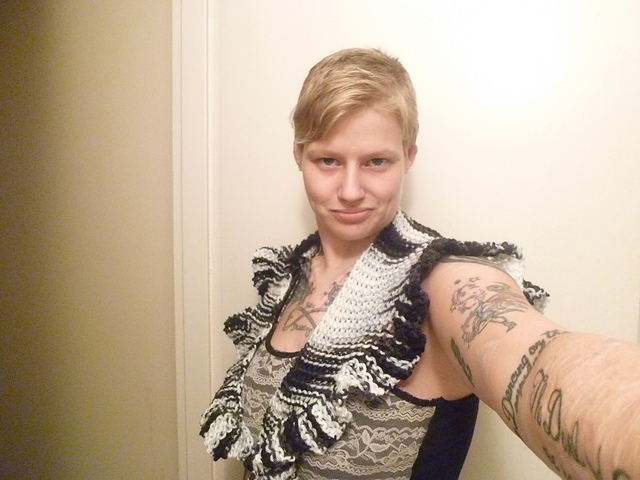
Eventually I found The Invisible Loom and saw a shawl ebook! I made my first shawl on the 36 peg Knifty Knitter. I later signed up for Ravelry and learned about different looms, like Authenetic Knitting Board, CinDwood Looms, Cottage Looms and more. I was making everything from socks to lace shawls, and I still couldn’t single crochet, but I could crochet cast on fast as hell.
What Is A Knitting Loom?

People instantly think of weaving and making potholders when they hear about “knitting looms” and it’s annoying and complicated to correct them. I refer to the icord makers that my mom said she had as a kid, the “knitting doll” or “knitting bee” which is basically a tiny loom, with (usually) 4 “pegs” that you wrap around, and hook over, to make icords. My mom said she used them to make rugs, or would seem them together. I found hers and made icords when I was a teenager. So I picked up the concept of loom knitting (well, e-wrapping) pretty quick.
With knitting looms, you can create pretty much everything from a simple hat to a fine gauge sock to a lacey and elegant shawl or a blanket. With people getting interested in them, and companies like KB and CinDwood making bigger, adjustable, looms with all sorts of options, there’s pretty much nothing you can’t do on a knitting loom.
 It’s also accessible, for those with less mobility, who get sore easier, who have trouble gripping, or carpal tunnel syndrome and related issues. CinDwood even sells a Clampable Loom for those that have less or no function in one arm.
The loom easily clamps onto a chair arm or wheelchair arm. I tested the small, easy to grip clamp and had no trouble attaching the loom to several chairs in my home as well as my wheelchair


Choosing A Knitting Loom?
Rake (Long) Looms
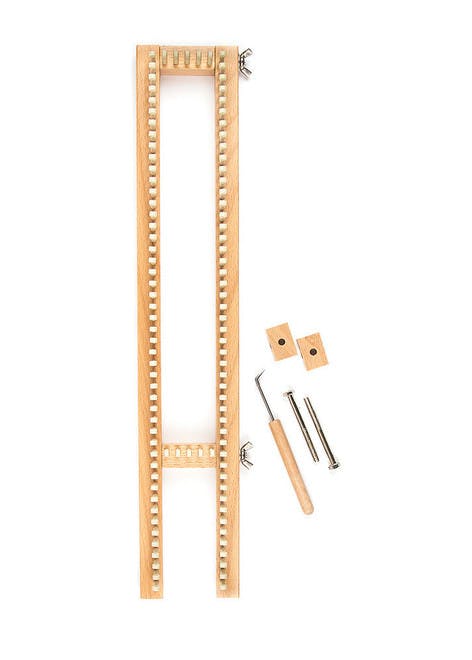
Long looms with double rows of pegs are for double knitting. (Some have a peg at each end so you can use them for circular knitting, and you can also always use these for single knitting.) Double knitting starts with a figure 8 cast-on, wrapping the yarn back and forth across the rows of pegs, which continues as you knit.

When doing single and double knitting, you can adjust the size of your project by working on only one portion of the loom. Some examples of rake or long looms are the KB All In One Loom or these plastic long looms that come in varying sizes and colours, similar to the old Knifty Knitter round sets.
 CinDwood and Cottage Looms also sell rake looms, and CinDwood has Line Looms which are used for 10 stitch blankets, afghan squares, dishcloths, and are also easy and slim to take with you if you’re travelling and want to knit something up without bothering the guy next to you on the plane.
Round Looms


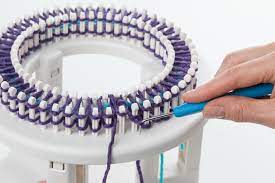
A round loom is different than a rake loom or line loom, because there is no definitive stopping point. You can continue weaving until you have achieved your desired size and shape. The type of loom you purchase depends on the shape you are interested in. The spacing between pegs, known as “gauge” determines what thickness of yarn to choose, how many pegs to use, and depends on project. There are many different gauged looms, such as small as a 3/16″ fine gauge loom, to the Zippy loom, which is about 1″ and uses the chunkiest yarn you can find.
 Most knitting looms are 3/8″ (small gauge, 1/2″ (regular gauge or 5/8″ (chunky.
You will find round, square, heart-shaped, triangular and square looms. A lot of people enjoy making tube-shaped items on a round loom because the loom is ideal for knitting in the round.
 You can make anything with a circular or round shape including hats, cowls, sleeves and socks, mittens, slippers, scarves, shawletts, even baby blankets. The more pegs, the more options. You can knit pretty much anything on a round loom, you can even even double knit with the KB rotating loom.


Afghan Looms

 Because knitting looms are a lot bigger than needles and work with pegs holding each stitch, knitting something pretty wide, like a blanket or shawl, can get big, quick. S-shaped looms, the most common afghan looms, are a neat way of compressing the length into an “S” shape and making it easier, more comfortable and takes up less space than a 5 or 6 foot long loom. Don’t get me wrong, though, the 4″ x 35″ CinDwood loom is pretty cool. I have an old version no longer sold, it’s 36″ and 1/2″ in gauge, and makes a flat panel of 72″ or double knit 36″. It’s hard to manage, though.
Sock Looms


 Sock looms are usually small gauge, round looms that may or may not be adjustable. The small gauge (small amount of spacing between pegs) is for sock yarn, which is fine gauge. Most sock looms are 1/4″ or 3/8″ in gauge. You can sometimes find 3/16″ ones, but 1/4″ is pretty good for most sock yarn.
Adjustable sock looms usually have a sliding part inside that you adjust and move back and forth to make the inner width bigger or smaller. They’re handy because you can make any size sock on them, but they can be difficult to use due to the shape and trying to loop pegs through. Sock looms can be used for mitts, and even small scarves and stuff, too. To knit socks, it’s a pretty good idea to learn grafting, or the kitchener stitch, a seamless way to bind off the toes.
Some books to get started:


Adjustable Looms
COMING SOON
How To Loom Knit
 It’s pretty easy to get started! Most people learn the basic e-wrap technique and then learn to purl and go from there. All you really need to know is how to cast on, knit, purl, and cast off, and you can make pretty much anything. Lace is just knitting or purling and moving loop from peg to peg. Cables are knitting and purling and moving from peg to peg. It looks complex, it’s actually pretty basic. And fun!
Base, Pegs, and Gauge

Pegs are the pieces you wrap or work your yarn around. They can come in different materials, usually plastic or wood, and are what loom knitting is all about.
Gauge is the space between pegs. The smaller the space, the smaller the gauge. 1/4″ or 3/8″ is great for stuff like socks, 1/2″ is “regular” gauge, 5/8″ is considered large gauge. Knifty Knitters looms, for everyone that started way back, are large gauge.
The base is the bottom that holds the pegs.
How Big Will My Project Be?

Row vs. Pegs
Peg count is vertical sizing and row count is horizontal sizing. They aren’t always the same! You can knit 10 rows of 10 stitches and you won’t get a perfect square as a result. It depends on a few things, like peg spacing, yarn thickness, type of stitch used and more.
Size vs. Stitch

Even vs. Odd Numbers of Pegs
COMING SOON
Peg Count vs. Loom Size
COMING SOON
Loom Shape and Project Shape

Single Knitting
In the Round
 When you knit in the round, you have a first peg, the one you cast on. You knit the pattern around the entire loom until you’re back at the first peg, then you restart the pattern at peg 1 again.
If you’re e-wrapping, a trick I do is knit around the entire loom, wrap each peg once, and then knit all of the pegs over, then wrap again, rather than doing it one by one.
Another trick, for garter stitch (one row knit, one row purl) is to wrap all of the pegs, and then when you come back to the next row, throw the loop on the peg over, purl the peg, then move to the next peg and repeat. It saves a tonne of time.
It doesn’t matter if you knit clockwise or counterclockwise. It’s whatever you prefer.
Flat Panel
In a flat panel you’re going back and forth from right to left and left to right. You do the pattern, reach the last peg, then go back in the opposite direction starting at the next row.
In needle knitting, in a flat panel, they have RS (right side) and WS (wrong side) because you alternate sides switching needles. You do not have an RS and WS in loom knitting, only RS, so if you’re using a needle knit pattern, you have to convert all RS to the opposite (all knits to purls, for example)
Knit Stitches
Single knitting is when you knit stitches on the pegs next to each other. This type of stitch is often referred to as “stockingette” and has a “right” and “wrong” side.

- E-wrap: Simplest, most widely used stitch, largest of the knit stitches. Called “twisted stockingette” in needle knitting.
- True Knit Stitch/Reverse Purl: Second largest knit stitch. Looks most similar to a tradition knit stitch done on needles.
- U-wrap: Quite tight.
- Flat knit: Very tight, stiff fabric at times. Smallest knit stitch.
Other Stitches


Double Knitting


LEARN!


